
B.C. Fisheries: Public Resource or Private Market?
How Local Fleets are Losing Access and the Urgent Case for Policy Reform
There is a quiet crisis unfolding on the West Coast of Canada. While our oceans remain productive, the communities that rely on them are being hollowed out. The reason isn't a lack of fish, it’s a policy gap that has transformed the B.C. fishery from a community-based food system into a speculative financial market.
The access to our public ocean resources are increasingly held by offshore investors and non-fishing entities. This leaves the active fishers to lease back the right to work at costs that consume the majority of their earnings. This is not merely an industry concern but a structural failure that threatens the economic stability and cultural heritage of the entire British Columbia coast.
Right now, the Standing Senate Committee on Fisheries and Oceans (POFO) is hearing testimony from the people on the water. The evidence being presented so far is a call to action to move past decades of study and finally implement policy changes that return the value of our oceans to the B.C. coastal communities.
The Great Maritime Rental Crisis
To understand what’s happening to our fishers, let’s look at the B.C. housing market.
Imagine if almost every home in your city was owned by a handful of offshore investment firms or massive corporations. Local families who want to live there are forced to pay up to 80% of their income in rent. These families do all the repairs, mow the lawn, and pay the property taxes, but they build zero equity. At the end of the month, they barely have enough left for groceries, while the investor, who has never even visited the neighbourhood and possibly doesn’t even live in the same country, gets richer.
This is very similar to how the West Coast fishery operates today. Under the current market-based system, fishing licenses and quotas have become tradeable financial assets. Many active harvesters don't own the right to fish - they lease it from ‘armchair harvesters’: investors, processing conglomerates, or foreign firms who never set foot on a boat.
The Breaking Point
The testimony provided recently to the Senate highlights a system at its limit:
Harvesters often pay so much in lease fees that they may only break even or, in some cases, lose money on a fishing trip. This leaves nothing behind for boat maintenance or equipment updates.
In her recent Senate testimony, Rebekah Pesicka, a commercial prawn harvester for over 40 years, highlighted that a single prawn license lease can cost $100,000 for one season. When the lease cost alone takes such a massive bite out of a season's revenue, one has to wonder: how can a young person possibly start a career? Many harvesters nearing retirement find themselves unable to pass their knowledge to the next generation. Their children are either priced out of the transition or simply uninterested in entering an industry where the economic math no longer supports a viable livelihood.
The Department of Fisheries and Oceans currently cites privacy as a reason for not tracking beneficial ownership. This lack of transparency allows a public resource to be managed in the dark, falling short of the standards we already expect in other sectors. We require a public registry for real estate through Land Title Offices so ownership is clear, and we require strict disclosure in banking through FINTRAC to prevent money laundering. Our oceans deserve the same level of accountability.
The Policy Divide
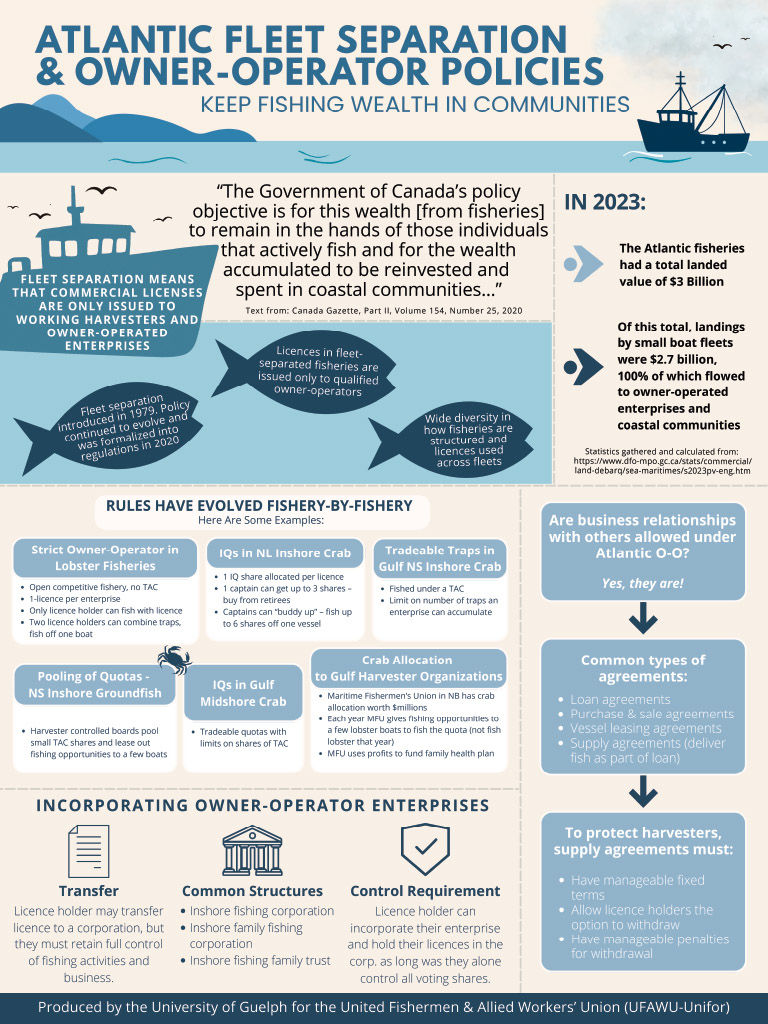
In the 1970s, B.C. was the model for fisheries management and the Atlantic was in crisis. The roles have completely flipped because the Atlantic implemented Owner Operator and Fleet Separation rules while B.C. did not. This proves that the current B.C. decline was a policy choice, not a result of geography.
Since we are one country, West Coast fisheries should be governed by the same foundational principles that protect Atlantic Canada. Aligning Pacific licensing policies with the successful Atlantic model would establish a fair, structured framework for our waters.
What Do "Owner-Operator" and "Fleet Separation" Actually Mean?
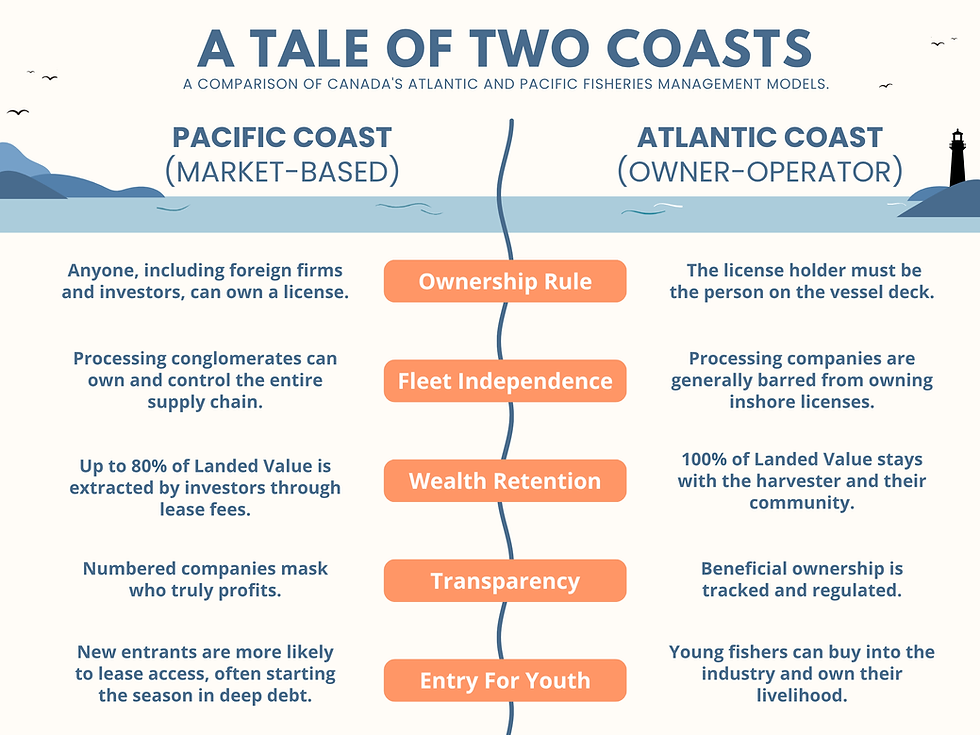
To fix the West Coast system, we need to understand the two regulatory pillars that have successfully anchored Atlantic Canada's coastal economies for decades. These are simple, common-sense rules designed to keep a public resource in local hands.
1. Fleet Separation (Keeping the ‘Factory’ Away from the ‘Fleet’)
Fleet Separation specifies that the processing sector (the factories, buyers, and large commercial distributors) cannot own commercial fishing licenses or quotas.
How it works: It separates the onshore processors from the active harvesters. This prevents a single corporate entity from dominating the supply chain, setting unfair dock prices, and forcing independent fishers out of business.
2. Owner-Operator (The 'Boots on the Boat' Rule)
The Owner-Operator policy states that the person who holds the commercial fishing license must be the person physically on the boat in some functional capacity.
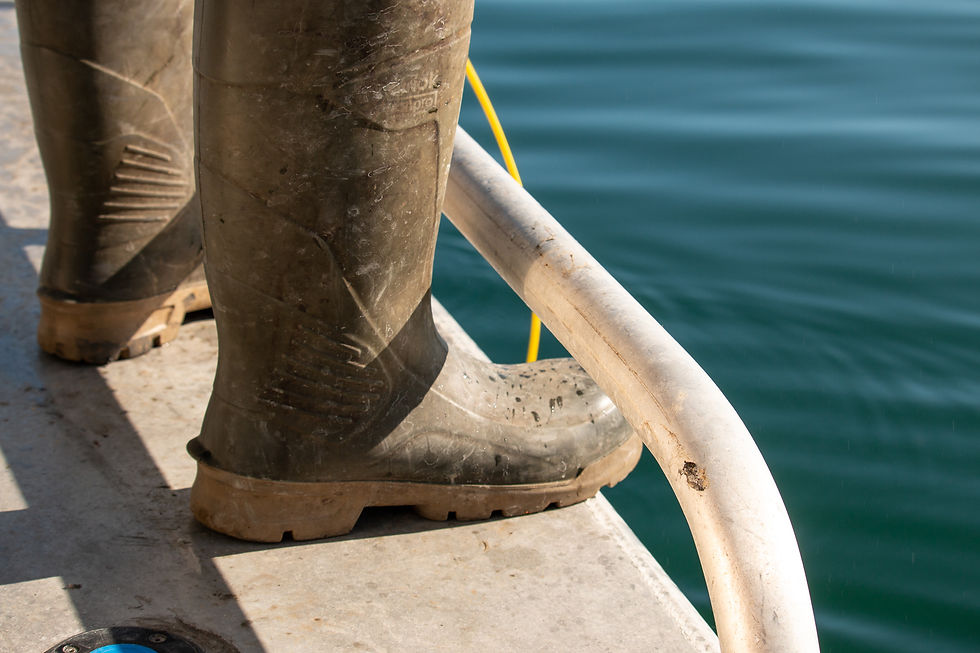
How it works: It legally outlaws the practice of armchair harvesting. You cannot buy up quotas and lease them out to local fishers at extremely increased rates. If you own the right to fish, you must have your boots on the deck.
Even corporate stakeholders acknowledge the power of this pride of ownership. Mike Frost, Director of Fisheries and Fleet Management for the Canfisco Group, stated in his recent Senate testimony that "...when people have ownership, they care more… they might be the most professional fish harvesters that we have."
A Roadmap for the Future: A Framework for Reform
During recent testimony, industry professionals and union representatives have made it clear that we cannot fix a system that remains invisible to the public. To rebuild an economically strong and sustainable Pacific fishery, stakeholders are calling on the Fisheries Minister to implement immediate policy changes by focusing on critical priorities, including these top three:
Align Pacific licensing policy with DFO Atlantic policy objectives
As has long been DFO policy in Atlantic Canada, DFO licensing in BC should be changed to protect independent owner-operator enterprises, to strengthen local control of fishing access rights, and to ensure benefits flow to First Nations and coastal communities.
A “made-in-BC” owner-operator model is the necessary first step
The Fisheries Minister should commit to transitioning toward fleet separation regulations for owner-operated enterprises, excluding fleets where the model is not viable (e.g., large groundfish trawl vessels).
Create a public registry of licence and quota beneficial ownership
A transparent registry that identifies the beneficial owner of licences and quota would improve access to available licences/quota, support the transition process, and help address foreign ownership and money laundering issues.

While these priorities establish a clear direction for reform, successful implementation will require a practical and equitable transition plan. Reform must recognize the realities of British Columbia's diverse fisheries, ensure fairness for current licence and quota holders, and provide working harvesters and First Nations with the tools needed to regain access and control.
While these priorities establish a clear direction for reform, successful implementation will require a practical and equitable transition plan. This transition should ensure fair treatment of non-harvester licence and quota holders through a phased, willing seller–willing buyer approach that allows time to recover investments, while also providing grandfathering provisions for retired harvesters who depend on licence leasing income. Fishery-specific implementation rules should be developed through extensive consultation with working harvesters to reflect the unique conditions of each fleet. At the same time, immediate measures are needed to address inequities in the current system by promoting fair leasing arrangements and preventing further consolidation of licences and quota by non-harvester investors.
"Paralysis comes from overanalysis... every journey begins with a single step. If we don’t take it, then we go nowhere." - Melanie Sonnenberg, President Canadian Independent Fish Harvesters' Federation
Bottom Line
We can no longer afford the political cycle of endless studies, departmental delays, and rotating Fisheries Ministers. While we wait for the next report or the next election, the people who actually power our coast are the ones left holding the bag.
“I really am not exaggerating when I fear that there won’t be a community-based fishing fleet in B.C. left to protect.... Within ten years, there will be very little left of any kind of an independent fleet." - Sonia Strobel, Co-Founder and Chief Executive Officer Skipper Otto Community Supported Fishery
The Pacific fishery is more than just an industry, it is a point of pride and the economic foundation of British Columbia. Our coastal communities have the skill and the passion to manage this world-class resource, but we are currently on a countdown. If we don’t move past this paralysis and implement structural changes now, we risk losing the very fishing fleet we could depend on for local economies and preserving skills and knowledge.
It is time to reclaim the value of our oceans and ensure that the wealth of our waters returns to the docks and the local families who have earned it. We must move the focus away from boardrooms and put the boots back on the boats, before it is too late.


Comments